
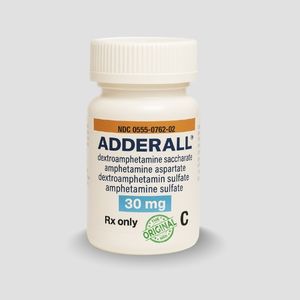
Description
Adderall
Pronunciation “ADD-ur” Name of the generic: amphetamine, dextroamphetamine
Other brands of dextroamphetamine and amphetamine are: Adderall, Adderall XR, Mydayis
Dosage format: oral tablets, extended-release tablets
Drug class: CNS stimulants
Medically examined in the hands of Carmen Pope, Senior Medical Editor, B. Pharm. Updated on August 20, 2026.
What is Adderall?
Adderall (mixed amphetamine and dextroamphetamine salts) is a central nerve system stimulant that is used to treat the condition of attention deficit hyperactivity disorder (ADHD) as well as a sleep disorder known as Narcolepsy. Adderall includes a mix of dextroamphetamine as well as amphetamine that affect the chemical balance that are found in nerves as well as the brain that are responsible for increased activity and impulse control.
- In the case of ADHD, Adderall is used for children ranging from 3 to 17 years old and also for adults. It could help improve concentration and reduce impulsivity and hyperactivity.
- To treat narcolepsy. Adderall is prescribed to patients aged 6 and above.
It’s not clear whether or not Adderall is safe effective in treating ADHD for children younger than three years of age, or for narcolepsy in children younger than six years old.
Adderall is an Federally restricted drug (CII) because it is a source of amphetamine. This can be a target of users of prescription drugs and street-based drugs. Be sure you keep Adderall in a secure place to safeguard the drug from theft. Don’t offer your Adderall to any other person, since it could cause harm or death. Giving away or selling Adderall is against the law.
Adderall can also be used for other purposes that aren’t covered in this guide.
Adderall (mixed amphetamine and dextroamphetamine sodium) was approved by FDA on the 19th of January in 1960. Extended-release versions that contain Adderall ( Adderall XR) are intended in the treatment of ADHD.
Warnings
Adderall comes with an Boxed Warn to avoid misuse, abuse and addiction.
Use, abuse and addiction
Adderall has a higher risk of misuse and abuse, and could lead to addiction issues, such as addiction. Misuse and abuse of Adderall, other amphetamine-containing medicines, and methylphenidate-containing medicines can lead to overdose and death. The danger of death and overdose increases by higher doses, or when the medication is administered in ways that aren’t authorized, such as taking snorts or injecting.
Adderall can cause physical dependence after long-term use, even when used as directed. Your doctor should examine your child or you for the possibility of misuse, abuse, and addiction prior to starting treatment. They will also monitor you or your child’s treatment. Inform your doctor if you or your child has had a problem with addiction or abuse prescription medications, alcohol or street drugs.
Heart-related risk
Stimulants can trigger strokes as well as heart attacks and sudden deaths in those who suffer from high blood pressure, cardiac disease, heart defect. Your healthcare provider should be able to check your child or you for heart issues prior to starting Adderall and should be monitoring your heart rate and blood pressure frequently throughout treatment.
Contact your doctor immediately or go to the nearest emergency room at a hospital If either you or your kid shows any symptoms of heart trouble like chest discomfort, breathlessness or fainting while receiving treatment.
Mental (psychiatric) problems
Adderall can result in new or worse mental and behavioral issues, or worse bipolar disorder, the appearance of new symptoms psychotic (such like hearing voices or imagining or believing in things that aren’t true) and new signs of depression. This is more likely when you’ve had a history of mental illness, depression and bipolar disorders. Talk to your healthcare provider about any mental issues you or your child suffer from or any family history of suicide, bipolar disorder or depression.
Contact your healthcare professional immediately if your child are experiencing any new or more severe mental symptoms that aren’t being treated including hearing voices, believing or seeing things that aren’t true or if you notice any new symptoms of manic.
Circulation issues
There is a possibility that you have blood circulation issues that may result in pain, numbness or discoloration of your toes and fingers. Consult your physician immediately in the event of unidentified wounds appearing on your fingers and toes after treatment.
Other alerts
Don’t use Adderall If you’ve used an MAO inhibitor within the last 14 days, including isocarboxazid and linezolid as well as phenelzin rasagiline, selegiline or tranylcypromine. Also, in the case of an injection of methylene blue. A potentially dangerous interaction between drugs could occur.
It is possible that you will not be able to take Adderall in the event of glaucoma, thyroid hyperactivity and excessive anxiety or agitation moderate to extreme high blood pressure coronary artery disease, vascular diseases or a past previous history of alcohol or drug dependence.
Adderall negative side effects
See a doctor immediately If you are experiencing symptoms warnings of an allergy reaction Adderall such as hives, difficulty breathing and swelling on your lips, face and tongue.
Serious side effects
Adderall can cause severe adverse effects. Consult your physician immediately If you suffer from:
- indications of heart issues for example, chest pain, breathing problems or the feeling that you could faint
- symptoms of psychosis signs of psychosis include hallucinations and behavior issues and hostility or paranoia
- indications of a problem with circulation signs of circulation issues, such as numbness discomfort, coldness and unidentified wounds. the appearance of your skin (pale or red blue appearance) on your fingers or toes
- a seizure
- muscles is twitching (tics)
- Changes within your eyes.
Check out the warnings above.
The slowing of growth (height as well as the weight) in children
Children are advised to be weighed and their height frequently during treatment and your healthcare professional might stop treatment if your child isn’t increasing weight in the way that is expected.
Serotonin syndrome
This issue can occur when Adderall is used in conjunction with other medications. It could be life-threatening. Stop using Adderall and seek medical attention immediately if you experience symptoms of hallucinations, agitation and sweating. rapid heart rate, shivering muscles, stiffness of the muscles or twitching. You may also experience nausea vomiting or diarrhea.
Common side effects
Common adverse effects of Adderall can include stomach discomfort, nausea and mood swings, weight loss being anxious, rapid heart rate, headaches dizziness, sleep issues (insomnia) and dry mouth.
This is not a comprehensive list of possible side effects and there are other possible side effects. Consult your physician for advice regarding medical the effects. You can report any adverse reactions to the FDA at 1-800-FDA-1088.
Before taking this medication, you must consult your physician.
Do not use Adderall If the child or you
- are susceptible to an allergy to amphetamine as well as any other other ingredients in Adderall (see the ingredients listed below for the ingredients)
- you are taking, or consumed within the last 14 days or have taken within the last 14 days, are taking, or have taken in the past 14 days, an MAO inhibitor, such as the antibiotic linezolid as well as the intravenous medicine Methylene Blue.
- There is an adrenal gland tumor that is rare known as Pheochromocytoma, a rare adrenal gland tumor.
Before you start taking Adderall be sure to inform your doctor about any medical condition you may have such as if you or someone in your family ever suffered from:
- heart diseases, heart problems heart defects, high blood pressure
- mental disorders, such as psychosis or bipolar illness or depression or the family history of bipolar illness, suicide or depression
- Problems with kidneys or the liver
- seizures or abnormal EEG test of the brain (EEG)
- circulation issues in the toes or fingers
- repetitive movements or sounds (tics) and Tourette’s Syndrome, or the family history of Tourette’s syndrome or tics.
Be sure to inform your physician if you’re planning to be pregnant, or if you are breastfeeding.
Adderall while pregnant can result in premature birth and low birth weight as well as withdrawal signs in your infant baby. Discuss with your healthcare provider whether you are expecting or are planning to be pregnant. There is a registry for pregnant women that gathers data about the health of women who have been who are exposed to Adderall and their infants.
Adderall is absorbed into the breast milk and can cause harm to a nursing infant. It is not recommended to give breastmilk during treatment with Adderall. Consult your doctor about the best method to feed your baby during treatment.
What is the best way to use Adderall?
You should take Adderall exactly as directed by your doctor. Follow all the instructions on the prescription label. Your doctor might alter the dosage. Be sure to not take this medication in greater or lesser amounts or for longer periods than the recommended time.
- First doses of your day are typically taken at the time you first get up.
- Adderall is a drug that can be used either with or without food.
- Do not chew or crush an extended release capsule. Swallow it whole. To ease swallowing you can break open the capsule and mix the medicine onto an applesauce spoonful, then take the whole mixture without chewing. Do not split the medicine inside the capsule and don’t save the mix for use later on.
Adderall can be addictive. Don’t share this medicine with anyone else, particularly those who have an history of substance abuse or addiction. Place the medicine in a place where other people aren’t able to access it.
When you are taking this medication the doctor you see will need to monitor your progress on regular intervals. Adderall may produce unusual results in certain tests, so inform your doctor that you’re taking this medication.
Dosing information
Usual adult dose for ADHD
Immediate-release (IR):
- Initial dosage: 5 mg orally every other or two times per day.
- Maintenance dose: The daily dose can be increased by 5 mg increments at intervals throughout the week until a suitable response is reached.
- Maximum dosage: Only in rare circumstances do you need to go over 40 mg daily.
- The first dose should be administered at the time of awakening. Followed by one to two doses every 4 to 6 hours.
Extended-release (XR), for patients who are beginning treatment for the first-time or switching to another medication:
- Initial dose: 20 mg taken orally every day, once.
The usual adult dose for narcolepsy
Immediate-release (IR):
- Initial dosage: 10 mg per day, divided into doses.
- Maintenance dose: The daily dose can be increased in increments of 10 mg every week until an optimal response has been attained.
- The typical dosage is between 5 and 60 mg per day, in divided doses, dependent on the response of each patient.
- The first dose is to be administered at the time of awakening. Then, one to two doses every 4 to 6 hours.
The usual dose for children is ADHD
immediate-release (IR), ages 3 to 5 years old:
- Initial dosage: 2.5 mg orally per day.
- Maintenance dose: The daily dose can be increased to 2.5 mg increments over weekly intervals until a satisfactory response is achieved.
immediate-release (IR), ages 6 to 17 years old:
- Initial dosage: 5 mg orally every other or two times per day.
- Maintenance dose: The daily dose can be increased by 5 mg increments each week until an optimal response has been attained.
- Maximum dose: Only in rare circumstances do you need to go over 40 mg daily.
Extended-release (XR), ages 6-12 years
- The first dose is 5 to 10 mg once per day in the early morning.
- Maintenance dose: The daily dose can be increased by 5-10 mg increments every week.
- Maximum dose: 30 mg per day.
Extended-release (XR), ages 13-17 years old:
- Initial dosage: 10 mg taken daily, orally.
- Maintenance dose: can get increased up to 20 mg daily after a week when symptoms aren’t adequately managed.
- Maximum dose: 30 mg per day.
The usual dose for children with narcolepsy.
Instant-release (IR), ages 6-11 years:
- Initial dose: 5 mg per day, divided into doses.
- Maintenance dose: The daily dose can be increased by 5 mg increments at intervals throughout the week until an optimal response is reached.
Instant-release (IR), ages 12 and over:
- Initial dose: 10 mg per day, divided into doses.
- Maintenance dose: The daily dose can be increased in increments of 10 mg every week until a satisfactory response is attained.
- The most common form of narcolepsy is in children less than 12 years old.
What happens if I don’t take an dose?
Do the missed dose when it is remembered, however not too late in the morning. Do not take taking the dose missed if you are close to evening. Do not take additional medicine to make up your missed dosage.
What happens when I take too much?
When you notice that your child is taking excessive amounts of Adderall contact your physician and the Poison Help line at 1-800-222-1222 or visit the nearest emergency room in a hospital immediately. In the event of an overdose, Adderall can be fatal.
Overdose symptoms can include tremors, restlessness muscles twitches, fast breathing and hallucinations. Other symptoms include confusion, hallucinations anxiety, panic, muscle weakness or pain, as well as dark-colored urine. These symptoms can be accompanied by fatigue and depression. Other symptoms include nausea, vomiting, diarrhea, stomach pain, uneven heartbeats, feeling light-headed, fainting, seizure, or coma.
What can you do to do to
This medication could impair your ability to think or react. Be aware if you are driving or engage in activities that require you to remain alert.
Beware of drinking juices made from fruit, as well as taking vitamins C the same time that you are taking Adderall. They can cause your body to take in less of the medicine.
What other medications can impact Adderall?
Talk to your doctor prior to using an acid-based stomach medicine (including sodium bicarbonate and Alka-Seltzer). Certain medicines may alter the way that the body metabolizes Adderall and can cause increased the effects.
Certain medications can interfere with dextroamphetamine or amphetamine and trigger a severe condition called serotonin disorder. Inform your doctor about all the medicines you are currently taking and any that you decide to start or stop using, in particular:
- Selective serotonin-reuptake inhibiters (SSRIs) along with serotonin reuptake inhibitors (SNRIs)
- tricyclic antidepressants
- medications that treat headaches caused by migraine, referred to as triptans
- tramadol, buspirone, lithium, fentanyl or tryptophan
- St. John’s Wort
- blood pressure medicine
- heartburn medicine
- A blood thinner like warfarin
- cold or allergy medication which contains decongestant
- opioid (narcotic) medicine
- seizure medicine.
This list isn’t complete and a variety of other drugs may interact with Adderall, which includes prescription and over-the counter medicines including vitamins, supplements, and herbal supplements. Make a list of all your medications to any doctor who will treat you. Do not begin any new medication while you are being treated with Adderall without speaking to your healthcare professional first.
What should I do to keep and dispose of Adderall?
- Store Adderall at room temperature between 68degF and the 77degF temperature range (20degC between 25degC and 20degC).
- Secure Adderall from the sun.
- Place Adderall in a secure place like a locked cabinet. Also, ensure it’s out of reach of children.
Remove any unused or expired Adderall via a take-back service at an US Drug Enforcement Administration (DEA) authorized collection facility. If there is no take-back program or DEA-authorized collector is in place then mix Adderall with a noxious or non-toxic substance like the cat’s litter, dirt or coffee grounds that have been used to reduce its appeal to pets and children. Mix the ingredients in a closed container like a plastic bag and dispose of it in the trash of your home. Visit www.fda.gov/drugdisposal for more information on disposing of unused medicines.
Adderall ingredients
Active ingredients: dextroamphetamine saccharate, amphetamine aspartate, dextroamphetamine sulfate, and amphetamine sulfate.
Inactive ingredients consist of colloidal silicon dioxide compliant sugar (sucrose and maltodextrin) as well as corn starch, magnesium stearate and microcrystalline cellulose as well as saccharin sodium. The tablet 5 mg is off-white to white and is free of colorants. The 7.5 mg tablets, as well as the 10 mg have an FD&C Blue #1 Lake of Aluminum. The 12.5 mg tablets, 15 mg, 20 mg along with the tablets of 30 mg contain FD&C Yellow #6 Aluminium Lake.
john –
Professional, proactive, and reliable.
eric zen –
Fantastic quality and price